



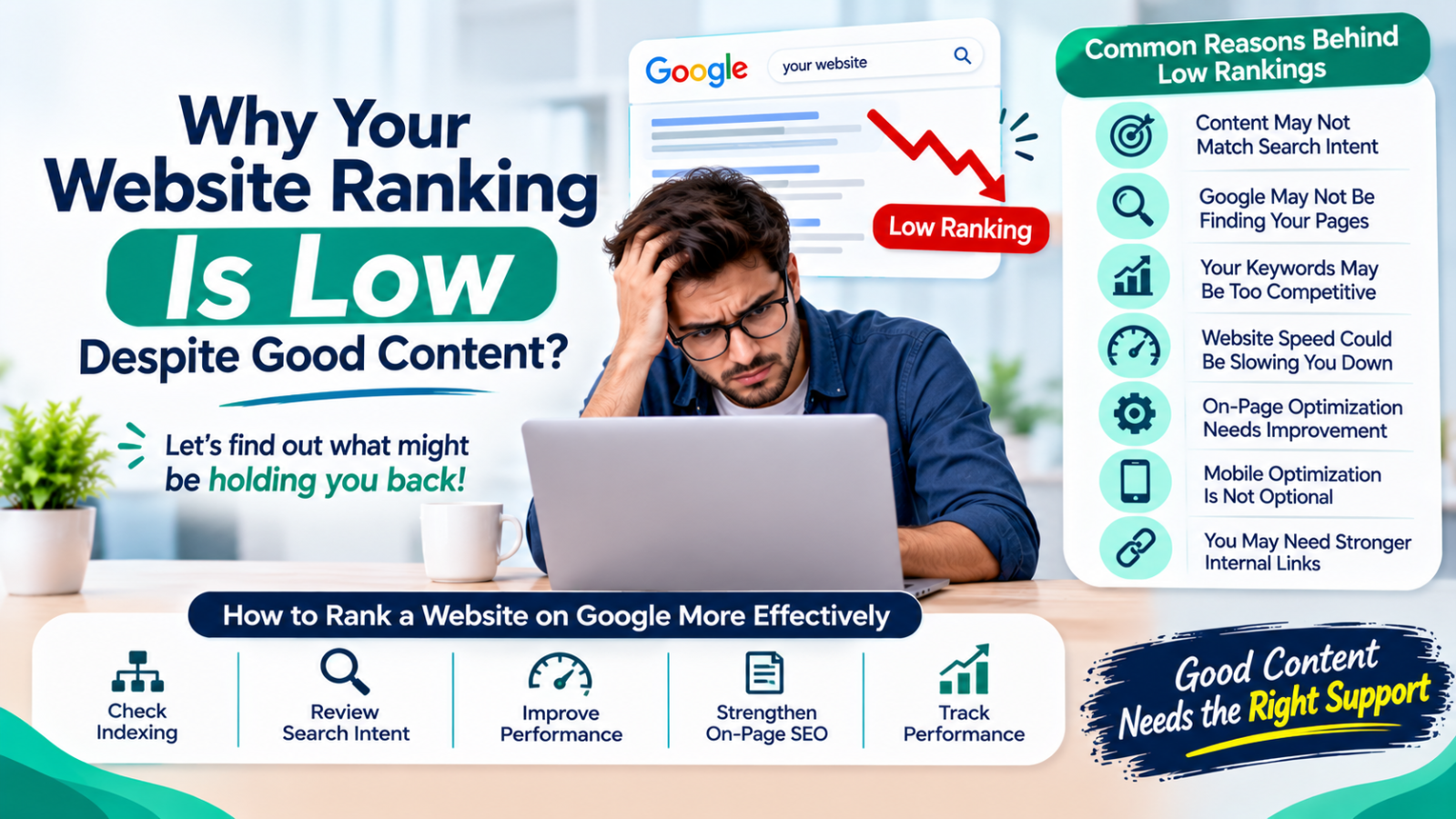
You have published useful blogs, written detailed service pages, and added the right keywords. So, why is your website still missing from Google’s top results?
It is frustrating when you put effort into creating good content but barely see any results.
The thing is, website ranking depends on more than how well an article is written. Search engines also need to discover your pages, understand their relevance, and determine how useful they are for a particular search.
Let’s look at what could be holding your website back.
Your Content May Not Match Search Intent
You can write an excellent article and still miss what your audience actually wants.
For example, someone searching for website design prices probably wants costs or packages, not a detailed explanation of what web design means.
Your content needs to answer the question behind the search, not just include the keyword.
Before creating a page, look at what people are searching for and the type of information they expect to find.
Google May Not Be Finding Your Pages
Even well-written content cannot attract organic search visibility if search engines cannot properly discover or index it.
Technical issues, incorrect indexing settings, broken internal links, or missing sitemap information can make it harder for search engines to access important pages.
Check whether your key pages are indexed and whether Google can crawl them correctly.
Sometimes, the problem is not the content itself. It is making sure the content can be found in the first place.
Your Keywords May Be Too Competitive
Targeting a popular keyword can seem like the fastest route to more visibility. But if established websites already dominate those results, ranking can be difficult.
Instead of focusing only on broad terms, explore more specific searches that match your services and audience.
For instance, a business offering website design to local businesses could target a relevant service and location rather than relying entirely on a broad keyword.
A smarter keyword strategy helps your content compete for searches that make sense for your business.
Website Speed Could Be Slowing You Down
A website may look impressive but still deliver a frustrating experience if its pages take too long to load.
Website speed optimization helps improve how quickly visitors can access your content and interact with your pages. Slow loading, unstable layouts, and delayed interactions can affect the overall user experience.
Review your site’s performance, especially on mobile devices. Compress oversized images, remove unnecessary scripts, and address technical issues affecting loading times.
Good content deserves a website that lets people access it easily.
Your Website Needs Better On-Page Optimization
Publishing content is only one part of the process. Each page also needs to communicate its topic clearly.
This is where page optimization matters. Relevant page titles, descriptive headings, useful internal links, and clear content structure help search engines and readers understand what a page offers.
Avoid adding keywords wherever they fit just to increase their frequency.
Instead, use them naturally and make sure every page has a clear purpose.
Mobile Optimization Is Not Optional
Many people discover businesses, read blogs, and compare services directly on their phones.
If your website has tiny text, difficult navigation, or buttons that are hard to tap, visitors may struggle to use it.
Mobile optimization helps ensure your website works well across different screen sizes. It also supports a better experience for people who want information quickly, without zooming in or navigating through cluttered layouts.
Check your important pages on an actual mobile device, not just on your desktop screen.
Your Website May Need Stronger Internal Links
Imagine publishing a helpful blog but giving visitors no way to discover related articles or services.
That content becomes an isolated page instead of part of a connected website.
Internal links help readers move between relevant pages and help search engines discover relationships between your content. Linking a blog to a related service page, for example, can make the overall site easier to navigate.
The key is relevance. Add links where they genuinely help the reader.
How to Rank a Website on Google More Effectively
So, how to rank website on Google when good content alone is not delivering results?
Start by reviewing the basics rather than publishing more pages without a clear plan.
– Check indexing: Make sure important pages are accessible to search engines.
– Review search intent: Ensure your content answers the questions your audience actually has.
– Improve performance: Address page speed and usability issues.
– Strengthen page optimization: Review titles, headings, internal links, and content structure.
– Track performance: Use tools such as Google Search Console to identify queries, impressions, clicks, and potential issues.
When deciding what we should optimize website for, focus on relevant searches, useful content, and a strong user experience instead of chasing rankings alone.
Good Content Needs the Right Support
If your website is not ranking, publishing another blog may not always be the answer.
The real opportunity could lie in improving technical accessibility, matching search intent, strengthening internal links, or making your website easier to use.
Effective website optimization brings these elements together so your content has a better chance of reaching the right audience.
Because creating good content is important.
Making sure people can find it is just as important.
Frequently Asked Questions
Why is my website not ranking despite good content?
Your website may face issues with indexing, search intent, keyword competition, technical SEO, page speed, or internal linking. Good content needs to work alongside these elements.
How to rank a website on Google?
Focus on helpful content, relevant keywords, proper indexing, strong internal links, technical SEO, and a positive user experience. Rankings can take time and are not guaranteed.
How does website optimization improve ranking?
Website optimization can help search engines access and understand your pages while improving usability, content structure, and overall site performance.
Does website speed affect ranking?
Page experience and performance matter, although speed alone does not determine rankings. Improving loading performance can also make your website more comfortable to use.
Why is mobile optimization important for SEO?
Mobile optimization helps visitors navigate and read your website on smaller screens. Google also uses the mobile version of a site’s content for indexing in most cases.