
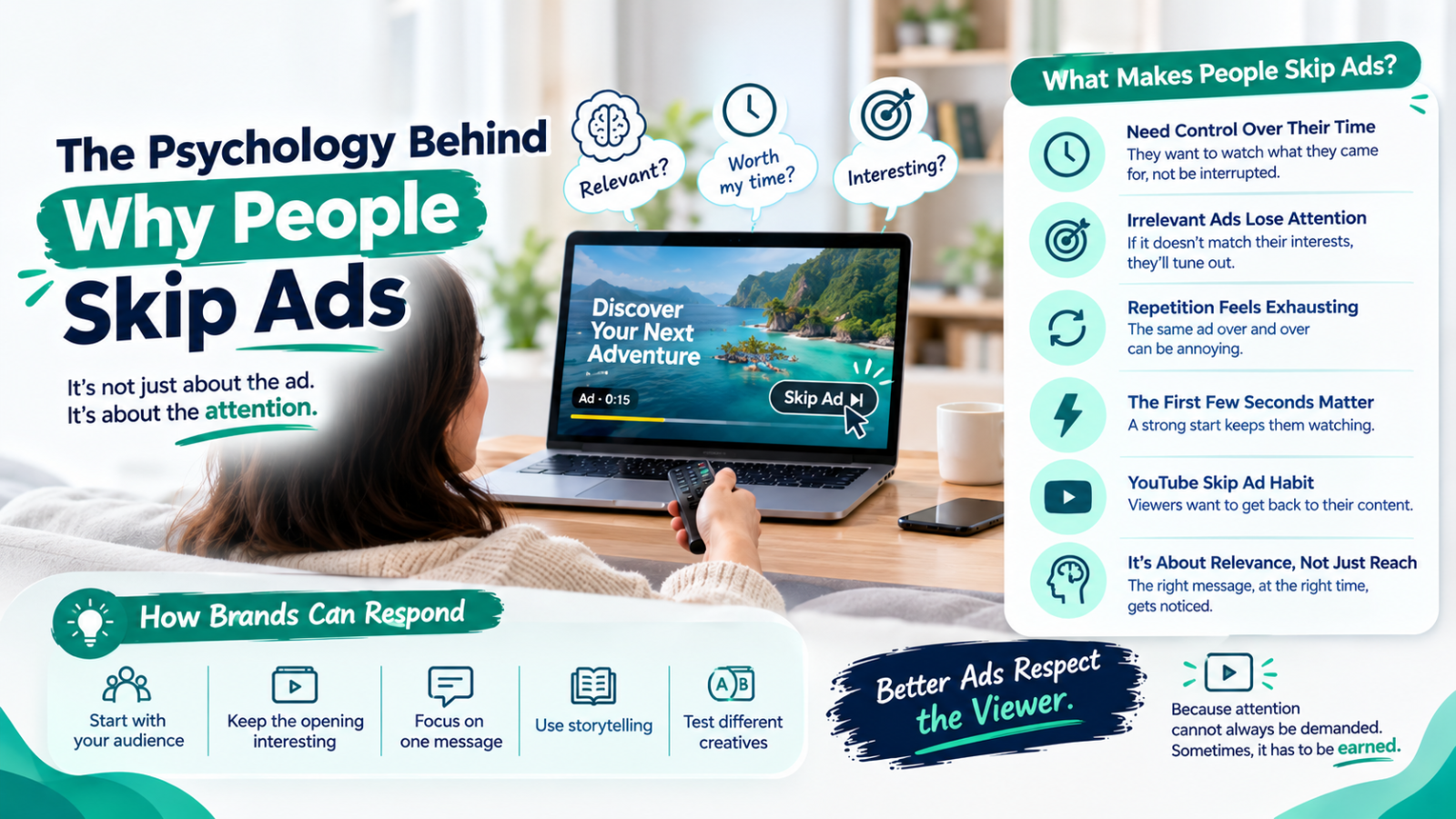
You click on a YouTube video, settle in, and an advertisement appears.
Your eyes immediately look for one thing: the **skip ad button**.
Sound familiar?
People encounter advertisements across videos, social media, websites, and mobile apps every day. Yet, many choose to scroll past, ignore, or skip them as soon as they get the chance.
For marketers, this raises an interesting question: what makes people give an ad a chance, and what makes them want to escape it?
People Want Control Over Their Time
When someone opens a video or scrolls through social media, they usually have a purpose. They want entertainment, information, or simply a break from their day.
An unexpected advertisement interrupts that experience.
The option to skip ads gives viewers some control over what they watch. When an ad feels like an obstacle between them and their intended content, skipping becomes the obvious choice.
For brands, the challenge is to make the interruption feel worth the viewer’s time.
Irrelevant Ads Lose Attention Quickly
Imagine watching a cooking tutorial and getting an advertisement for a product that has nothing to do with your interests.
You might ignore it without a second thought.
Relevance plays an important role in whether people pay attention. When an ad connects with a viewer’s interests, needs, or current situation, it has a better chance of holding their attention.
This does not mean every advertisement needs perfect targeting. Sometimes, a relatable idea or an interesting message is enough to make someone curious.
Repetition Can Make Ads Feel Exhausting
Seeing the same advertisement once might make you notice it.
Seeing it repeatedly can make you want to avoid it.
When people encounter the same creative too often, the message can start feeling predictable and irritating. Instead of making the brand more memorable in a positive way, repetition may encourage viewers to tune out.
Brands need to refresh their creative ideas, test different approaches, and avoid relying on one advertisement for too long.
Familiarity can help. Overexposure can work against it.
The First Few Seconds Matter
Online audiences make quick decisions about what deserves their attention.
If an advertisement takes too long to introduce its idea, viewers may lose interest before the message gets going.
A strong opening can create curiosity, introduce a relatable situation or show the benefit of a product without unnecessary buildup.
The goal is not to squeeze the entire sales pitch into the first few seconds. It is to give viewers a reason to keep watching.
Why People Skip Ads on YouTube
The habit of choosing to skip ads on YouTube is a simple example of how people respond to interruptions.
Viewers usually arrive with a specific video in mind. When an advertisement delays the content they want, the skip option becomes an easy way to return to it.
For advertisers, this makes the opening especially important. Starting with a long logo animation or a generic introduction may not give viewers much reason to stay.
A relevant question, an interesting visual, or a clear demonstration can make the opening more engaging without relying on loud effects or exaggerated claims.
The Skip Ad Button Changes How Brands Communicate
The skip ad button creates a small but important moment of choice.
Viewers can decide whether the advertisement deserves more of their attention. That means brands cannot depend entirely on forcing exposure. They need to create something worth watching.
This changes how advertisers should approach their creative strategy. The message needs to be clear, the opening needs a purpose, and the content should give viewers a reason to remain interested.
An ad may have only a short window to make an impression, but that window can still be used thoughtfully.
How Brands Can Respond to Skip Ads Behavior
Understanding skip ads behavior can help brands create advertising that feels more relevant and less intrusive.
Here are a few practical ways to approach it:
– Start with the audience: Build the message around a real need, interest, or situation your audience can relate to.
– Keep the opening interesting: Introduce the main idea early instead of making viewers wait for the point.
– Focus on one message: Avoid packing too many benefits, offers and claims into a single ad.
– Use storytelling: A short, relatable scenario can make the message more engaging than a list of product features.
– Test different creatives: Compare different openings, visuals, and messages to understand what resonates with your audience.
The aim is not to trick people into watching. It is to give them a genuine reason to pay attention.
Better Ads Respect the Viewer
People skipping advertisements is not necessarily a sign that they dislike a brand or its products. Sometimes, the timing is wrong. Sometimes, the message is irrelevant. And sometimes, the viewer simply wants to get back to what they were doing.
That is why effective advertising needs more than visibility. It needs an understanding of the audience, a clear message, and creative execution that respects people’s time.
The next time you plan a campaign, think beyond how many people will see the ad.
Think about why they would want to watch it.
Because attention cannot always be demanded.
Sometimes, it has to be earned.
Frequently Asked Questions
Why do people skip ads?
People may skip ads because they interrupt the content they want, feel irrelevant, repeat too often, or fail to capture their interest.
Why do people skip ads on YouTube?
Viewers often want to reach their selected video without delays. If an advertisement does not interest them, they may use the skip option as soon as it becomes available.
What are skippable ads?
Skippable ads are advertisements that allow viewers to skip the remaining portion after a specified period, depending on the platform and ad format.
How does the skip ad button affect advertising?
The skip ad button gives viewers more control over their viewing experience, encouraging advertisers to make their messages engaging early in the ad.
How can brands reduce skip ads behavior?
Brands can improve their chances of holding attention by making ads relevant, starting with an engaging idea, keeping messages clear, and testing different creative approaches.