
One gets people talking about your brand. The other gets people clicking, signing up, or buying.
Sounds like you have to pick a side, right?
Not quite.
The conversation around brand marketing vs performance marketing often makes the two sound like competing teams. In reality, they solve different marketing problems. Understanding what each does can help brands decide where their time and budget need to go.
What Is Performance Marketing?
Performance marketing is a results-focused approach where campaigns are designed around measurable actions.
These actions could include clicks, leads, app installs, purchases or other conversions, depending on the campaign objective.
The big attraction is the ability to track performance and use the data to make campaign decisions.
What Makes Performance Marketing Different?
Performance campaigns are usually built around measurable outcomes.
Marketers can monitor metrics such as cost per lead, conversion rate, return on ad spend, and other campaign-specific results.
This makes performance marketing particularly useful when a brand has a clear action it wants its audience to take.
What Is Brand Marketing?
Brand marketing focuses on building how people perceive, recognise, and remember a brand.
Instead of asking only, “Did someone buy?”, it also considers questions like:
Do people know us? Do they remember us? What do they associate us with?
Brand campaigns can use storytelling, creative campaigns, social media, content, experiences, and brand advertising to build those associations over time.
Brand Marketing vs Performance Marketing: The Key Difference
The easiest way to understand brand marketing vs performance marketing is to look at what each is trying to achieve.
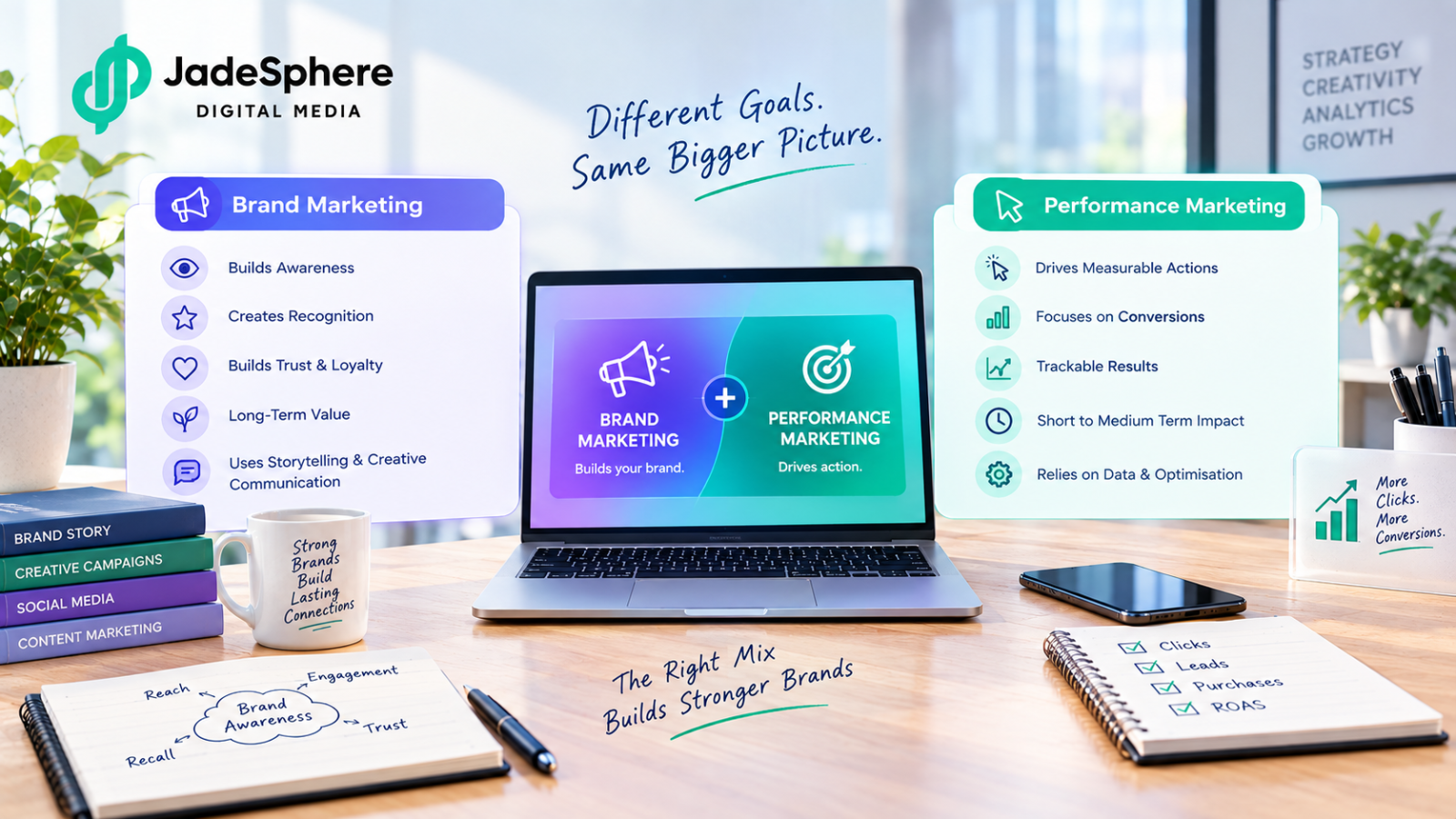
Brand Marketing | Performance Marketing |
Builds awareness and recognition | Drives measurable actions |
Focuses on long-term brand value | Focuses on trackable campaign outcomes |
Uses storytelling and creative communication | Relies heavily on data and optimisation |
Builds familiarity and trust | Encourages actions such as clicks or conversions |
Results may take longer to measure | Results can often be tracked more directly |
Neither approach exists in isolation. A person may discover a brand through a memorable campaign and later convert through a performance ad.
When Does Performance Marketing Make Sense?
Performance marketing can be useful when your goal is specific and measurable.
For example, a business launching an e-commerce offer may want to drive purchases. A B2B company may want to generate qualified leads. A new app may want to encourage downloads.
In these situations, having clear conversion goals makes it easier to track what the campaign is achieving.
When Does Brand Marketing Make Sense?
Brand marketing becomes important when the bigger goal is to build recognition and long-term preference.
A new brand may need to introduce itself to the market. An established brand may want to change perceptions, strengthen its identity, or stay memorable in a crowded category.
This is where brand marketing and brand advertising can play a larger role.
Can Brands Measure Brand Marketing?
Yes, but not always in the same way as performance campaigns.
Brands can look at measures such as awareness, reach, engagement, brand recall, search interest, and changes in audience perception.
The important thing is not to expect every brand campaign to behave like a conversion campaign. A campaign designed to build familiarity may not generate immediate sales, but that does not make the activity impossible to evaluate.
Should You Choose One Over the Other?
This is where the comparison gets interesting.
A brand focused only on performance can become very good at converting people who are already ready to act, while missing opportunities to build wider awareness.
At the same time, a brand investing only in awareness may struggle to turn that attention into measurable business outcomes.
The right mix depends on the brand, its goals, audience, category, and stage of growth.
How the Two Can Work Together
Think of marketing as a journey.
Brand marketing can help put your brand on someone’s radar and give them a reason to remember it.
Performance marketing can then help move interested audiences towards a specific action.
One builds the relationship. The other can help move the relationship forward.
And sometimes, the same campaign can do a little bit of both.
So, Where Should Your Brand Invest?
There is no universal percentage that every brand should put into brand marketing or performance marketing.
A better starting point is to ask:
What is the business trying to achieve?
Is the immediate priority awareness or action?
How familiar is the audience with the brand?
What does the customer journey look like?
What can realistically be measured?
The answers can help determine where the balance needs to sit.
Because the real question is not brand marketing vs performance marketing.
It is what does your brand need right now?
Frequently Asked Questions
What is the difference between brand marketing and performance marketing?
Brand marketing focuses on building awareness, recognition, and long-term brand value, while performance marketing focuses on measurable actions such as leads, clicks, or purchases.
What is performance marketing used for?
Performance marketing is commonly used when brands have specific, measurable goals such as generating leads, driving sales, increasing website actions or acquiring customers.
What is brand advertising?
Brand advertising is advertising designed primarily to build awareness, recognition, associations and familiarity with a brand rather than focusing only on immediate conversions.
Can a brand use both strategies?
Yes. Brands can combine brand marketing and performance marketing as part of a broader strategy, with each supporting different stages of the customer journey.
Is brand marketing harder to measure than performance marketing?
Brand marketing can be measured, but its metrics are often different from direct-response campaigns. Measures such as awareness, reach, recall, and audience perception can help evaluate its impact.