
Running an ad on Instagram or Facebook is easy. Getting people to actually care about it? That is where things get interesting.
A campaign can have a great-looking creative, a decent budget, and a perfectly polished landing page, yet still fail to deliver the results you expected.
That is why Meta Ads Manager should not just be treated as the place where you press “Publish”. It gives brands the data, controls and campaign options needed to understand what is working and what needs a rethink.
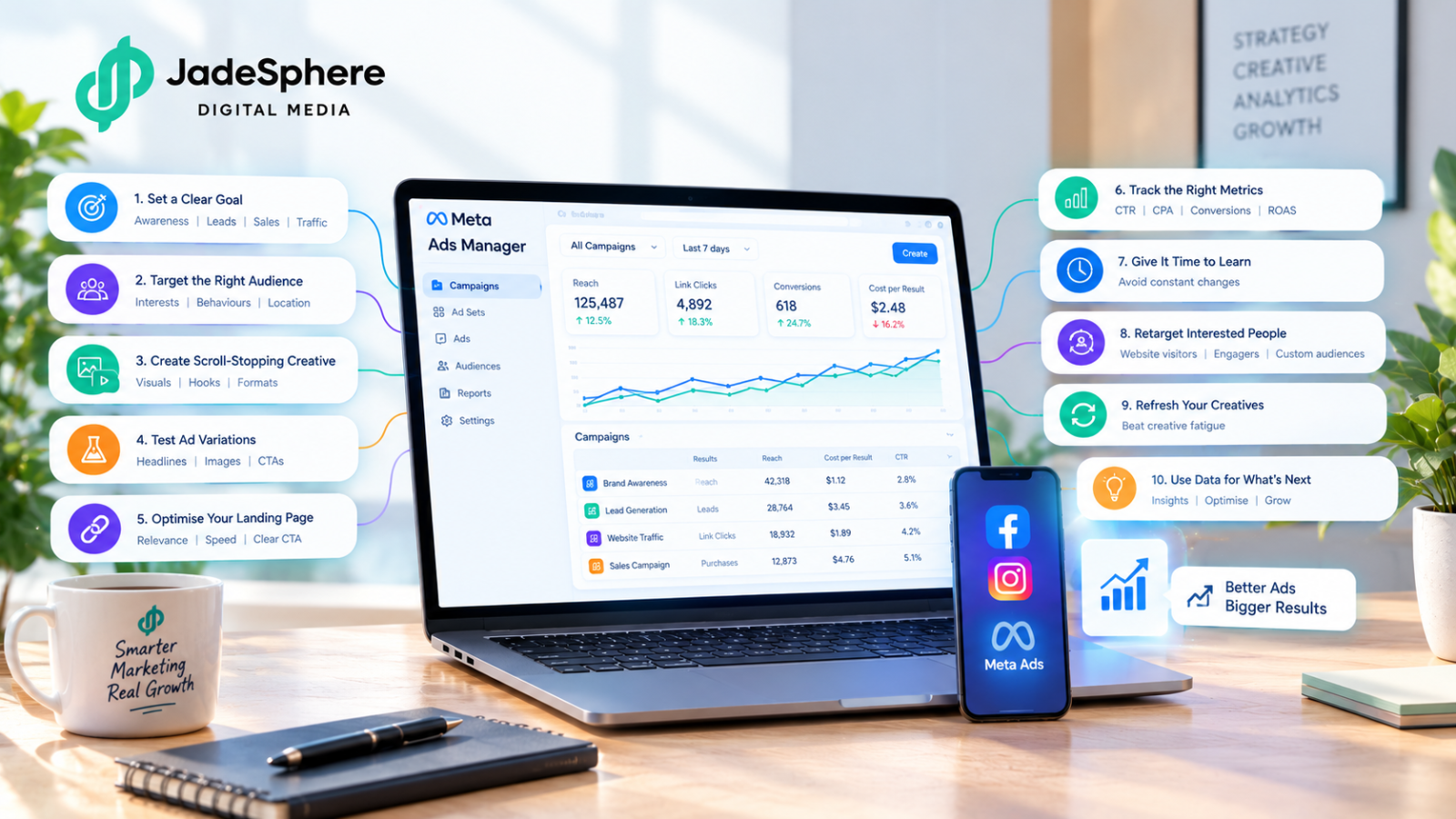
Here are 10 ways to make your campaigns work smarter.
1. Start With a Clear Campaign Goal
Before touching your targeting, creative, or budget, know what you want the campaign to achieve.
Are you looking for website traffic, leads, purchases, app activity, or awareness?
Your objective influences how Meta delivers your ads. A campaign without a clear goal can quickly turn into spending money and hoping for the best.
2. Know Exactly Who You Are Talking To
“Everyone” is rarely a useful target audience.
Think about your customer’s interests, behaviours, location, age group, and stage in the buying journey. The more clearly you understand the person behind the click, the easier it becomes to create relevant ads.
Good Meta advertising starts with understanding people, not just selecting audience settings.
3. Give Your Creative a Reason to Stop the Scroll
Your audience is not sitting around waiting for your ad to appear.
Your creative has a few seconds to earn attention. Strong hooks, clear messaging, interesting visuals, and platform-friendly formats can make a difference.
Test different concepts rather than simply changing the background colour and calling it a new creative.
4. Test Different Ad Variations
One ad does not give you enough information to know what your audience prefers.
Experiment with different headlines, visuals, formats, hooks, and calls to action. Meta Ads Manager can then help you understand which variations are getting stronger responses.
The goal is not to guess the winning ad. It is to give the data enough room to tell you.
5. Stop Ignoring Your Landing Page
Imagine clicking a brilliant ad and landing on a page that looks confusing, loads slowly, or has no obvious next step.
Not exactly a dream customer experience.
Your ad and landing page should feel connected. The promise made in the ad should match what users find after clicking, with a clear action for them to take.
6. Watch the Right Metrics
A campaign generating thousands of impressions might look impressive at first glance. But impressions alone do not tell the whole story.
Look at metrics that connect with your campaign goal, such as click-through rate, cost per result, conversions, and return on ad spend where relevant.
The important question is not “How many people saw it?” but “What happened after they saw it?”
7. Give Your Campaign Enough Room to Learn
Constantly changing a campaign can make it difficult to understand what is actually working.
Avoid making major changes every few hours simply because the numbers moved. Give campaigns appropriate time and data to evaluate performance, while still keeping an eye on spend and results.
Sometimes optimisation means knowing when not to touch something.
8. Retarget People Who Already Know You
Someone who visited your website, interacted with your content, or engaged with your brand may already have some familiarity with you.
Retargeting can help bring these audiences back with messaging suited to their stage in the journey.
A person who has already shown interest does not necessarily need the same introduction as someone discovering your brand for the first time.
9. Refresh Your Ads Before They Become Background Noise
Even a successful creative can eventually lose its impact.
If people keep seeing the same ad repeatedly, engagement can drop, and the campaign may become less effective. Keep testing fresh visuals, hooks, and messaging while retaining the elements that are already working.
Creative fatigue is your reminder that “it worked once” does not mean “it works forever.”
10. Use the Data to Make the Next Decision
The real value of Meta Ads Manager is not just the numbers sitting inside it. It is what you do with those numbers.
Look at which audiences responded, which creatives attracted attention, and where users dropped off. Then use those insights to improve the next campaign.
Every campaign should teach you something.
What Is Meta Marketing?
So, what is Meta marketing?
It refers broadly to marketing activities across Meta’s platforms, including Facebook and Instagram. This can include paid advertising, audience engagement, content, and other brand-building activities.
Meta advertising is one part of this larger ecosystem, giving businesses tools to reach specific audiences and promote products, services or content.
Better Meta Ads Start With Better Decisions
There is no magic button inside Meta Ads Manager that suddenly turns an average campaign into a great one.
Performance comes from a combination of strategy, creative thinking, audience understanding, testing, and constant learning.
The platform gives you the tools.
What you do with them is where the real marketing happens.
Frequently Asked Questions
What is Meta Ads Manager?
Meta Ads Manager is Meta’s platform for creating, managing, and analysing advertising campaigns across its platforms.
What is Meta advertising used for?
Meta advertising can be used for goals such as building awareness, driving website traffic, generating leads, promoting products, and encouraging conversions.
What is Meta marketing?
Meta marketing refers to marketing activities carried out across Meta’s ecosystem, including organic and paid efforts on platforms such as Facebook and Instagram.
How can I improve my Meta Ads performance?
Start by reviewing your campaign objective, audience, creative, landing page, and performance data. Testing different approaches can help identify what resonates with your audience.
How often should Meta ads be changed?
There is no fixed schedule that works for every campaign. Monitor performance and audience response, and refresh creatives when performance or engagement indicates that a change may be useful.